
A ready office space for rent provides businesses with a furnished, operational workplace that can be occupied with significantly less preparation than a conventional office. Instead of coordinating an office fit-out, furniture, basic infrastructure and multiple facilities arrangements separately, companies can move into a workspace where many of these requirements are already established.
This model is particularly relevant to fast-growing businesses because expansion often creates immediate workspace requirements. A company may recruit several employees within a short period, establish a new project team, open a Singapore operation or require additional space before its long-term property requirements are fully known.
Conventional office arrangements can make these situations more complicated. Securing premises is only one stage of establishing an office. Businesses may also need to plan the layout, arrange furniture, coordinate connectivity, manage utilities and prepare meeting and reception facilities before employees can use the space effectively.
A ready office changes this sequence. The workspace provider prepares and manages much of the physical office environment, allowing the tenant to concentrate on its own employees, systems and business activities.
For startups, SMEs, regional teams and project-based organisations, fully furnished office rental solutions can therefore provide a practical way to establish or expand a physical workplace while keeping office requirements adaptable.
Why Ready-to-Use Office Solutions Are Becoming More Relevant
Ready-to-use office solutions are becoming more relevant because businesses increasingly need workplaces that can respond quickly to recruitment, expansion and changing working arrangements.
Modern organisations do not always grow according to predictable long-term plans. A business can secure a new project, hire employees, restructure a department or enter another market within a relatively short period.
Physical office requirements can change as a result.
Traditional office planning typically requires businesses to anticipate their future space requirements well in advance. This can be difficult for companies experiencing rapid growth because the number of employees, departments and workstations required several years from now may be uncertain.
Ready offices provide another approach. Companies can use an established workplace for their current operations while retaining greater ability to reconsider their workspace requirements as the organisation develops.
Several business trends have increased the relevance of this model:
- More companies operate with hybrid or distributed teams.
- Startups and SMEs may experience rapid changes in headcount.
- International companies increasingly establish smaller market-entry teams before expanding.
- Project-based organisations may require temporary additional capacity.
- Businesses place greater emphasis on operational agility.
These factors do not make conventional offices unsuitable. Organisations with stable long-term requirements or highly specialised workplace needs may still prefer traditional premises.
Ready offices are particularly useful when speed, operational simplicity and adaptability are important to the organisation.
What Is a Ready Office Space?
A ready office space is a furnished and prepared workplace that businesses can occupy without completing the extensive physical setup commonly associated with traditional commercial premises.
It is sometimes described as a move-in-ready, plug-and-play or serviced office. Although terminology varies between providers, the underlying principle is similar: much of the basic office infrastructure is already available.
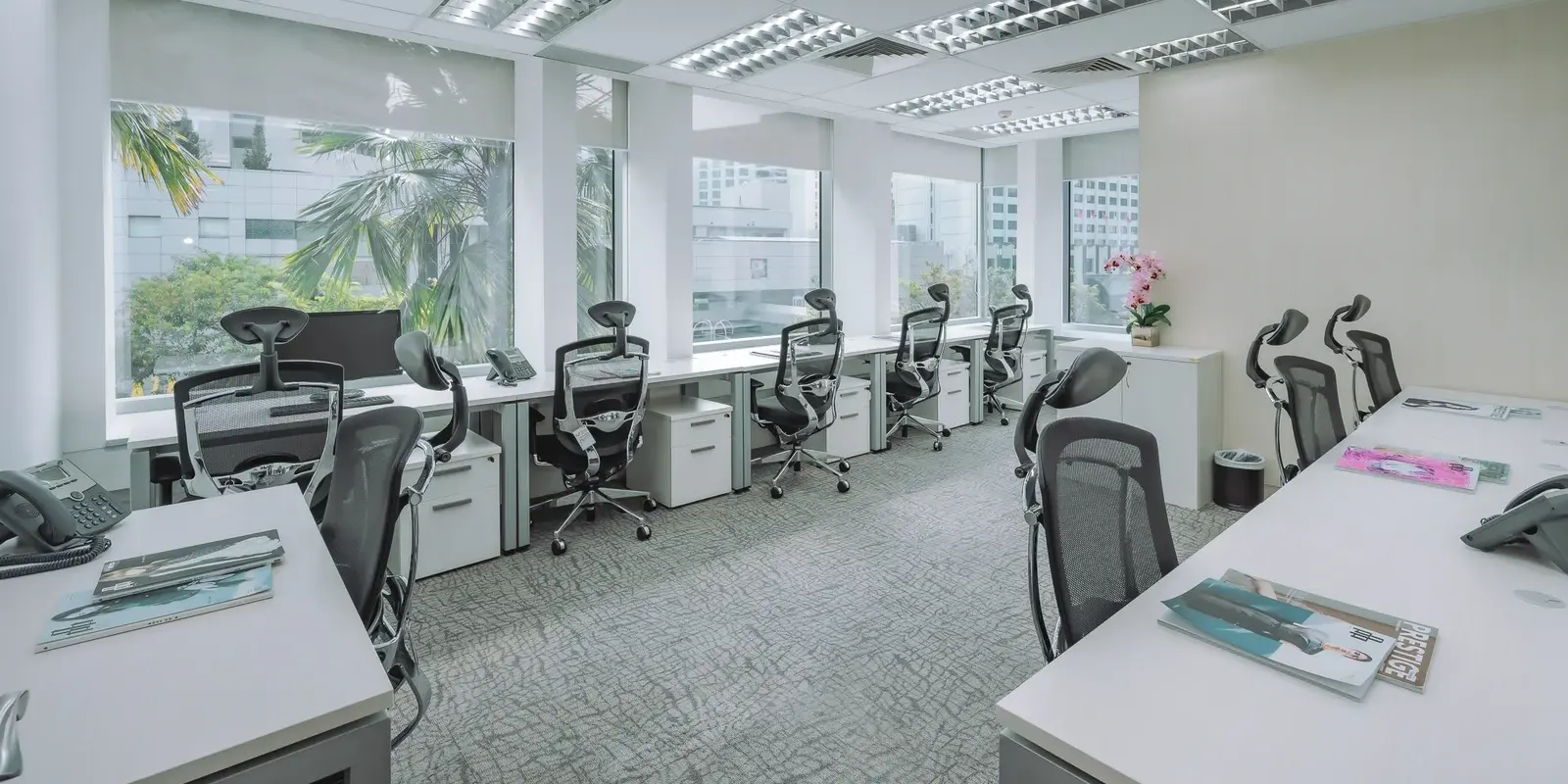
A typical ready office may include desks, chairs, storage, internet connectivity and access to common facilities. Depending on the provider, businesses may also have access to reception support, meeting rooms, maintenance, cleaning and other workplace services.
The office is therefore not simply an empty commercial unit.
The provider has already established an environment designed for business operations.
What Does “Plug-and-Play” Mean for an Office?
A plug-and-play commercial office solution is a workspace where essential physical infrastructure is already installed so that the tenant can begin operating with fewer setup requirements.
The term does not mean that absolutely everything a company needs is automatically provided.
Businesses still need to prepare their own computers, software, internal systems, cybersecurity arrangements, employee equipment and organisation-specific processes.
The “ready” element primarily refers to the physical workplace.
A business should therefore verify the exact inclusions rather than assuming that every ready office provides identical services.
A Ready Office Space Versus a Traditional Office
A ready office space differs from a traditional office primarily in the amount of setup and facilities management handled by the tenant.
A conventional commercial lease generally gives the business greater responsibility for establishing and maintaining its own workplace. A ready office transfers more of those physical and operational responsibilities to the workspace provider.
The practical differences can be summarised as follows:
| Consideration | Ready Office Space | Traditional Office |
|---|---|---|
| Initial condition | Usually furnished and prepared | May require substantial setup |
| Furniture | Commonly included | Usually arranged by tenant |
| Workspace infrastructure | Largely established | Often coordinated separately |
| Internet connectivity | Commonly available | Usually arranged by tenant |
| Maintenance | Often provider-managed | Greater tenant responsibility |
| Shared meeting facilities | Frequently available | Depends on premises |
| Setup timeframe | Usually shorter | Often requires more preparation |
| Office management | More centralised | More independently managed |
| Customisation | Usually more limited | Often greater |
Neither format is inherently better for every organisation.
Traditional offices can provide greater control over design, branding, configuration and specialised facilities. Ready offices prioritise operational convenience, speed and adaptability.
The appropriate choice depends on what the business requires from its workplace.
Why Fast-Growing Businesses Prefer Ready Office Spaces
Fast-growing businesses often prefer ready office spaces because their physical workplace requirements can change faster than conventional office planning processes can accommodate.
Growth creates several practical challenges.
More employees require more desks. New departments may need private rooms. Client activity may increase demand for meeting facilities. A new project can create temporary workspace requirements that did not exist when the organisation selected its original premises.
A ready office can respond to some of these requirements without forcing the company to establish an entirely new workplace infrastructure.
Faster Response to Recruitment
Rapid recruitment can create an immediate need for additional workspace.
When a company hires new employees, it must provide more than employment contracts and computers. Employees also need an appropriate environment in which to work, collaborate and meet.
If the business has to establish a conventional office before employees can use it, workplace preparation may become another stage in the expansion process.
An instant workspace setup for businesses can reduce this delay because the physical office has already been prepared.
The organisation can concentrate on employee onboarding and internal systems rather than simultaneously coordinating furniture, connectivity and office facilities.
Supporting New Departments and Teams
Growing organisations frequently create new teams as their operations become more specialised.
A startup may initially have employees performing several functions. As it develops, it may establish separate sales, operations, finance, customer service or management teams.
These structural changes can alter workspace requirements.
Some teams may require quiet private offices. Others may rely heavily on meeting facilities or collaborative spaces.
A ready office provider with different workspace configurations can give the organisation more options as these requirements develop.
Speed of Setup as an Operational Advantage
A shorter office setup process can help businesses begin using a workplace sooner when operational requirements change.
Establishing a traditional office involves multiple stages that may need to occur sequentially.
The company first needs to identify suitable premises. It may then need to plan the office layout, coordinate contractors, arrange furniture, install connectivity and complete other workplace preparations.
The exact process depends on the premises and business requirements, but each stage can add complexity.
A ready office has already completed much of this physical preparation.
This can be particularly useful when the workspace requirement is linked to a time-sensitive business event.
Examples include:
- A company has recruited employees who need a workplace.
- A new client project requires a dedicated team.
- An overseas organisation is establishing a Singapore operation.
- A department needs temporary additional capacity.
- A business is relocating and requires continuity between premises.
In these situations, the value of a ready office is not simply convenience. It can help reduce the time between identifying a workspace requirement and providing employees with an operational workplace.
Reduced Upfront Setup Requirements
Ready office rentals reduce the amount of physical office infrastructure that businesses need to organise before occupying a workplace.
A conventional office may require a company to coordinate several different setup activities. These can include space planning, furniture, telecommunications infrastructure, meeting areas, reception arrangements and other physical requirements.
Each activity involves management attention and may require separate suppliers.
Fully furnished office rental solutions centralise many of these elements.
The provider prepares the workplace before the business occupies it, reducing the number of setup tasks that the tenant needs to manage directly.
This can be especially relevant for smaller organisations.
A large enterprise may have property, procurement, technology and facilities teams capable of managing a new office project. A growing SME may not have the same internal resources.
For these businesses, reducing setup requirements can allow employees to remain focused on commercial operations rather than becoming temporary office project managers.

More Predictable Office Administration
Ready offices can make office administration more predictable by consolidating multiple workplace services within a managed arrangement.
Traditional premises can involve several separate operational relationships.
The business may deal independently with building management, internet providers, cleaning companies, maintenance contractors, furniture suppliers and other service providers.
A managed workspace centralises more of these responsibilities.
This does not remove every administrative responsibility from the business. Companies still need to manage their own employees, equipment, internal technology, security procedures and business processes.
However, the physical workplace can become easier to administer.
For growing companies, this matters because administrative complexity tends to increase as the organisation expands.
Reducing unnecessary workplace coordination can help internal teams focus on functions that directly support the organisation's operations.
Operational Benefits for Businesses
A ready office space provides operational benefits by combining physical workspace with facilities and services required for normal business activity.
The exact services vary by provider, but the underlying model is designed to reduce the number of office-related tasks handled independently by the tenant.
Furniture and Workstations
Furnished offices provide employees with basic workplace infrastructure from the beginning of occupancy.
This avoids the need to purchase, deliver and install an entire office furniture package before the team can begin working.
Businesses should still assess whether the available furniture and layout suit employee requirements.
Internet Connectivity
Reliable internet connectivity is essential for most modern businesses.
Ready offices commonly provide connectivity as part of the workplace infrastructure, although companies should confirm service specifications and security arrangements.
Businesses with specialised networking requirements should discuss them with the provider before selecting the space.
Maintenance and Cleaning
Maintenance and cleaning are ongoing requirements rather than one-time setup tasks.
When these services are managed by the provider, the tenant has fewer facilities responsibilities to coordinate directly.
This can be particularly useful for companies without an internal office management team.
Reception and Visitor Management
A managed reception area can provide a structured point of contact for visitors.
Depending on the provider, reception services may help direct guests, support meeting arrangements and contribute to the everyday functioning of the workplace.
Meeting Facilities
Meeting rooms allow businesses to host discussions without permanently allocating part of their private office to a conference space.
This can be efficient for teams that need professional meeting facilities periodically but do not use them continuously.
The Role of Managed Office Services
Managed office services transfer selected workplace responsibilities to the office provider so that businesses do not have to administer every physical aspect of their premises independently.
This model is particularly useful for organisations that require a professional office but do not want to establish an internal facilities operation.
Managed office spaces for growing companies may include several supporting functions within the same workplace arrangement.
For example, the provider may oversee common-area maintenance while the tenant focuses on its own private office. Shared facilities may be maintained centrally rather than individually by each company.
The practical benefit is operational simplification.
Instead of dealing with multiple workplace issues through different external parties, the business has a more centralised office environment.
Companies should still understand the boundaries of provider responsibility. IT support, employee equipment, specialised security systems and company-specific workplace requirements may remain the responsibility of the tenant.
Flexibility and Scalability Options
Flexible business workspace leasing options allow companies to reconsider their office requirements as their workforce or operational needs change.
Scalability is particularly important for fast-growing organisations because office requirements are rarely static.
A company with eight employees today may have twelve employees several months later. A project team may double temporarily before returning to its original size. An overseas business may begin with a small Singapore team and expand after establishing its market presence.
Ready office environments can support these situations when the provider offers different office configurations and has suitable availability.
Expanding Into a Larger Office
A growing team may eventually require more workstations or a larger private office.
Moving within the same managed workspace environment can potentially be simpler than relocating to completely new premises because the organisation may retain access to familiar facilities and services.
Expansion options should nevertheless be confirmed in advance.
No provider can guarantee that every office size will always be available when required.
Adjusting to a Smaller Team
Business requirements can also decrease.
A completed project, organisational restructuring or increased remote working may reduce the number of employees using the office regularly.
A flexible arrangement can provide more options for adjusting the workspace when contractual conditions and available configurations permit.
Adding Temporary Capacity
Some businesses require additional workspace only for a defined period.
This may happen during major projects, seasonal operational periods or temporary recruitment programmes.
Ready offices can provide an alternative to modifying permanent premises for short-term capacity requirements.
Ready Office Space and Hybrid Work
A ready office space can support hybrid work by providing a professional physical base without requiring companies to design their workplace entirely around full daily attendance.
Hybrid teams divide work between the office and other locations.
This changes how businesses calculate their physical space requirements.
A company with a particular employee headcount may not need an identical number of permanent workstations if employees attend the office on different days.
Ready office environments can provide a central location for activities that benefit from physical interaction, including:
- Team collaboration
- Client meetings
- Training sessions
- Interviews
- Project discussions
The office can therefore function as a business hub rather than simply a collection of permanently assigned desks.
However, the workspace needs to match the organisation's hybrid working policies.
Companies should understand peak attendance, meeting room demand and privacy requirements before deciding how much office capacity is appropriate.
Supporting Business Expansion Into Singapore
A ready office space can provide international businesses with an operational workplace while they establish and develop their Singapore presence.
Market entry often begins with a relatively small team.
An organisation may appoint local employees, relocate several regional staff or create a temporary market-entry group before deciding on the long-term scale of its Singapore operations.
Establishing a fully customised office immediately may not match this stage of development.
A ready office provides an alternative by giving the company a functioning workplace while its requirements become clearer.
The business can use the location for employee activities, meetings and day-to-day operations without first creating the physical office infrastructure independently.
This does not replace the legal and regulatory processes required to establish a business in Singapore. Companies remain responsible for appropriate corporate registration, employment, tax and regulatory obligations.
The ready office addresses the physical workspace component of expansion.
Professional Environment and Business Image
A professional office environment provides a consistent setting for employees, clients and business partners.
Physical workplaces continue to serve important functions even as remote and hybrid working become more common.
Businesses may need appropriate spaces for confidential discussions, interviews, presentations, collaborative sessions and client meetings.
A ready office can provide these facilities without requiring a company to establish them independently.
The suitability of the environment depends on several practical factors.
Businesses should assess the condition of the workplace, privacy, sound levels, meeting facilities, reception arrangements and accessibility.
Location and Accessibility

Location affects how easily employees, clients and business partners can reach a ready office.
In Singapore, proximity to MRT stations and major transport connections can influence the practical usability of a workplace.
A centrally located office may be useful for businesses that regularly meet clients or work with partners across different parts of Singapore.
However, the most appropriate location is not necessarily the same for every organisation.
A business should consider:
- Where employees commute from
- How often clients visit
- Proximity to relevant commercial districts
- Public transport accessibility
- Nearby services and amenities
Location should therefore be evaluated in relation to the company's everyday operations.
A prestigious address has limited practical value if employees and clients consistently find the location difficult to reach.
Technology and Security Considerations
Technology and security should be assessed before occupying a ready office space because furnished premises do not automatically satisfy every company's technical requirements.
Most ready offices provide basic connectivity, but businesses may have different network, cybersecurity and data protection requirements.
Companies should establish whether the workspace can support their internal technology policies.
Important questions may include network configuration, internet reliability, physical access procedures and whether the business can install additional equipment where required.
Companies operating in regulated industries may need more detailed assessments.
The workspace provider manages the office environment, but each organisation remains responsible for protecting its own information, devices and business systems.
Ideal Industries and Business Types
Ready office spaces are particularly suitable for organisations that value speed of setup, managed facilities and the ability to adjust workspace requirements.
The model can support several types of businesses.
Startups
Startups often operate with uncertain growth projections.
A ready office allows an early-stage business to establish a professional workplace without spending significant management time coordinating the physical setup of an office.
The company can concentrate on employees, customers and operations while using existing workplace infrastructure.
Small and Medium-Sized Enterprises
SMEs may benefit from ready offices because they can access professional facilities without creating a dedicated facilities management function.
This can be useful for organisations that require private workspace, meeting rooms and administrative support but want to keep office management relatively simple.
Remote and Hybrid Teams
Distributed teams may need a central physical location for collaboration even when employees do not work from the office every day.
A ready workspace can provide this base while allowing the company to plan office capacity around actual attendance.
Project-Based Organisations
Project teams may need temporary workspace for a specific assignment.
A ready office can provide the necessary environment without requiring the company to establish permanent premises for a temporary operational requirement.
International Companies
Overseas organisations establishing Singapore operations can use a ready office space while their local workforce and long-term property requirements develop.
This can provide a practical starting point for a regional or local team.
Corporate and Enterprise Teams
Larger companies can also use plug-and-play commercial office solutions for temporary teams, satellite operations, additional capacity or specific business functions. Ready offices are therefore not limited to small businesses.
How to Evaluate a Ready Office Space
A business should evaluate a ready office space according to operational suitability rather than selecting a workplace based only on appearance or immediate availability.
The office needs to support current requirements while providing reasonable options if those requirements change.
1. Determine the Required Workspace Size
Businesses should begin by assessing how many employees will regularly use the office. Hybrid working patterns should be considered because total employee headcount may differ from peak daily attendance.
2. Review the Workspace Layout
The physical configuration should match how the team works. Private offices, collaborative areas and meeting rooms serve different purposes. A company handling confidential information may have different requirements from a highly collaborative project team.
3. Confirm What Is Included
Businesses should identify exactly what the provider manages. Furniture, connectivity, meeting room access, reception support, maintenance and cleaning arrangements should be clear before the office is selected.
4. Assess Accessibility
The location should be practical for employees and visitors. Transport links, building access and surrounding amenities can affect everyday workplace usability.
5. Review Technology Requirements
Businesses should confirm that the available connectivity and infrastructure support their operations. Companies with specialised technical requirements may need additional arrangements.
6. Consider Future Workspace Changes
A growing business should understand what options exist if the current office becomes unsuitable. This includes potential access to larger offices, additional workstations or alternative configurations.
Common Mistakes When Selecting a Ready Office
Common mistakes occur when businesses focus on immediate occupancy while overlooking how the workspace will function over time.
A ready office may be available quickly, but it still requires proper evaluation.
One mistake is choosing an office based solely on current headcount. A company experiencing rapid recruitment should also consider whether additional capacity may be required.
Another mistake is assuming that all managed offices include the same services. Facilities, meeting room policies, connectivity and administrative support can vary between providers.
Businesses may also underestimate location requirements. An office can meet internal specifications but still create operational difficulties if employees or clients cannot access it conveniently.
Finally, companies sometimes overlook privacy and technology requirements because the physical office appears complete.
Move-in-ready should not be interpreted as automatically suitable.
The workspace still needs to be assessed against the organisation's specific operational, technical and security requirements.
Building a Practical Ready-Office Strategy
A practical ready-office strategy aligns the physical workplace with the organisation's current operations and expected changes.
The process should begin with business requirements rather than property specifications.
Companies can use the following approach:
Define the Immediate Requirement: Identify why the workspace is needed and when employees need to begin using it.
Assess Actual Attendance: Determine how many people are likely to use the office at the same time.
Identify Essential Facilities: Establish requirements for private offices, meeting rooms, connectivity and visitor access.
Consider Likely Changes: Account for recruitment, project timelines, hybrid working and potential expansion.
Evaluate Provider Capability: Confirm whether the workspace can accommodate reasonable future changes.
This method helps prevent the company from selecting an office that solves only the immediate requirement.
A ready office is most useful when it supports both current operations and a realistic range of future workplace needs.
Frequently Asked Questions (FAQs)
What does a ready office space for rent mean?
A ready office space for rent refers to a furnished workplace that has already been prepared for business use. It commonly includes workstations and basic office infrastructure, while additional facilities such as meeting rooms, internet connectivity and reception services depend on the provider.
How quickly can a business use a ready office?
Ready offices generally require less physical preparation than traditional premises because the furniture and core workplace infrastructure are already established. The actual move-in timeframe depends on availability, contractual requirements, company equipment and any organisation-specific setup that is still required.
Is a ready office space the same as a serviced office?
The terms can overlap because both commonly describe furnished workplaces supported by managed services. However, providers may define their products differently, so businesses should review the actual facilities, workspace configuration and contractual conditions rather than relying on terminology alone.
Can a growing company expand within a ready office?
Expansion may be possible when the provider has larger offices or additional workspace available. Companies expecting significant growth should discuss potential expansion options before selecting their initial office because future availability cannot always be guaranteed.
Are ready offices suitable for hybrid teams?
Ready offices can suit hybrid teams because they provide a central workplace for collaboration, meetings and focused work without necessarily requiring a dedicated desk for every employee. Businesses should plan capacity according to peak attendance rather than total headcount alone.
Do ready offices include meeting rooms?
Many ready office environments provide access to shared meeting facilities, but arrangements vary between providers. Businesses should confirm room availability, booking procedures and usage conditions before choosing a workspace.
Are ready offices suitable for overseas companies entering Singapore?
Ready offices can provide overseas companies with an operational workplace while their Singapore teams develop. The office addresses physical workspace requirements, while the company remains responsible for the legal, regulatory and administrative requirements associated with operating in Singapore.
What should businesses check before moving into a ready office?
Businesses should review workspace size, layout, connectivity, privacy, accessibility, service inclusions and options for future expansion. They should also ensure that the environment supports their internal technology and security requirements.
A Practical Workspace Model for Growing Operations
A ready office space can help growing businesses establish or expand their physical workplace without managing every element of office setup independently. Furnished workstations, established infrastructure and provider-managed facilities can reduce the operational work required before employees begin using the office.
The model can be particularly relevant to startups, SMEs, project teams, hybrid organisations and international companies establishing operations in Singapore. It can also support larger businesses that require temporary or additional workspace.
Ready offices should still be evaluated carefully. A move-in-ready workplace is useful only when its location, configuration, infrastructure, privacy and services match the organisation's requirements.
For fast-growing businesses, the central advantage is operational readiness. The workplace can be established around current business requirements while preserving greater ability to respond as teams, projects and working arrangements develop.
Discuss a Ready Workspace for Your Business Requirements
Businesses considering ready office spaces for rent can assess whether a furnished and managed workspace is appropriate for their team size, working arrangements and expected development.
Centennial Business Suites provides ready office environments for businesses seeking professional workspace with established facilities and managed services. To discuss workspace availability and determine which arrangement may suit your organisation, please reach out to our team via email at [email protected] or call/WhatsApp on (+65) 9230 2206.